Myford refurbishment continues – shaft competed


 Today I only managed to complete the lever that releases tension on the countershaft/headstock belt. It is surprising to me still on how much I underestimate time required for each task.

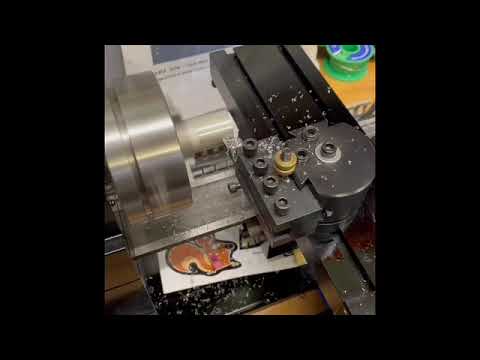
No real problems were encountered and I had a chance to use my tailstock die holder for the first time, and it was great. One problem I did encounter however was the size of the aluminum ball for the end of the shaft. My ball turning tool I built to make the chess set was too small for the size of ball I wanted to turn so a compromise size had to be made. However it will do the job and I can make a larger one if I want to later on when I make a Mk2 version.

When fitting the shaft everything fitted nicely so it was a job worth doing. The next stage will be to carry on with the rebuild.

Completed Myford shaft


Shaft in situ

Stop press: The leadscrew has just been delivered so tomorrow I will start on making the new leadscrew.

About Mike Freeman

Hello, my name is Mike Freeman and I am a retired Chief Fire Officer from the United Kingdom with a keen interest in model engineering, silver caddy spoons and sea fishing. I live in the pretty fishing port of Brixham, South Devon, in the United Kingdom. I am a sufferer of degenerative osteoarthritis, which impacts on the amount of time I can spend in the workshop, and is the reason why you will see seats and a stool in some of the photo's. I have only recently added the above sentence after a discussion with one of my Doctor's from the excellent pain clinic, based in Torbay. This does affect concentration one of the reasons why I double then re-double my measurements and set ups. Before completing nearly 30 years of public service I and my wife Sandy, owned and ran, a small restaurant in Okehampton Devon. Prior to marriage I worked for my father in his various businesses, in the early days these were garages, which he bought in a run down state, then built them up before moving on, to start again. I took every opportunity in those early days, to work in his workshop's learning 'on the job' rather than as an apprentice. This, I suspect, is the reason why my building various model's in the early days, turned into model engineering, when funds allowed the required equipment to be bought. My workshop comprises one half of a detached double garage. It has a stud wall separating the two halves and unusually perhaps, its own shower/toilet/washbasin compartment! (the true reason for buying the bungalow - don't tell the wife!!!) It is fully insulated with a ceiling and fluorescent lighting supplementing the one window. Several double electrical sockets are dotted around in relevant positions. Equipment consists of 2 lathes (1 Myford ML 10 and 1 Chinese variable speed motor with etched glass DRO's), 1 milling machine (RF25 far East) floor standing pillar drill, Proxxon bandsaw, Warco bandsaw, 6" wire brush and polishing mop motor, 6" coarse and fine grinder, Proxxon mini drill, various benches and an engineers vice. I have just acquired a third lathe, a Myford ML7 which I am at present evaluating so I can decide which of the Myford's I will keep. I have only just bought the Chinese lathe and had it fitted with DRO's prior to delivery. And what a bonus they are! So good in fact that I decided to buy another set for the Milling machine. Whilst my engineering experience can only be described as limited, I find the use of DRO's has affected my accuracy levels which have improved tremendously (although that's not saying much!) and would recommend their fitting to any model engineer. Prior to retirement I built for my son's 17th birthday a Locost car. This was a tremendous project and a great feeling when it passed its test. The book it was based on suggests it can be built for £250. Ours was nothing special in the sense of all new parts but still cost about £900 to build!
This entry was posted in General posts, myford refurbishment. Bookmark the permalink.

3 Responses to Myford refurbishment continues – shaft competed

  1. What did you estimate for this job and how long did it take? There’s approx 10 operations to make that handly, between 30mins and an hour a job? So between 5 and 10 hours would be my guess.

  2. Mike Freeman says:

    Hello Andy, I must admit I don’t estimmate before I start. Maninly because i always underestimate and since I don’t need to account for my time its something I don’t need to do.

    I will admit I am not a fast worker as I have to check and reheck everything because concentration goes….. In sessions, it took two, and my sessions vary between 4 and 6 hours. So your estimates are better than mine! Its a good job I don’t have to pay for my time, you could never afford to do it. If you said you earned say £20 per hour then this small job would be between £160 to £240 jsut for labour! Puts the cost of tooling etc. into perspective!

  3. I picked up some thoughts on estimation when I was at Dowty Aerospace as a trainee engineer. Typically setting up takes as long or longer than the machining so that’s where you can save time by ensuring as many machining operations as possible can be done per setup.

Leave a Reply

Your email address will not be published. Required fields are marked *

*

You may use these HTML tags and attributes: <a href="" title=""> <abbr title=""> <acronym title=""> <b> <blockquote cite=""> <cite> <code> <del datetime=""> <em> <i> <q cite=""> <strike> <strong>

Follow Me